Top Cake Drum Board Manufacturers for Global Buyers

Time:2026-10-22 Author:Liam
0%

Choosing a Cake Drum Board manufacturer involves more than comparing prices or attractive product photos. Global buyers need dependable materials, accurate sizing, stable construction, and practical export support. A board may look strong on a catalog page, yet bend under a tall wedding cake. That difference matters.

Nicholas Lodge, an internationally recognized cake artist and educator, once stated, “A cake board must support the design before it supports the decoration.” This principle remains useful for professional purchasing. The right Cake Drum Board should match the cake’s weight, height, moisture level, and delivery conditions. Buyers should examine board thickness, paper wrapping, edge finishing, food-contact documentation, and production consistency. Clear samples help. So do factory audits.

This guide introduces leading Cake Drum Board manufacturers serving global buyers. It considers material options, custom printing, minimum order quantities, packaging, lead times, and shipping experience. It also compares suppliers that support bakeries, wholesalers, supermarkets, and large-scale cake studios. Strong manufacturers explain their testing process. Reliable ones communicate problems early.

No list is perfect. Supplier performance can change with capacity, raw-material costs, and regional logistics. That is why buyers should request current samples and written specifications before placing substantial orders. A beautiful board is not enough. It must arrive flat, clean, and ready for real bakery work.
Top Cake Drum Board Manufacturers for Global Buyers

Cake Drum Boards Explained: 6–15 mm Thickness, Materials, and Load Ratings

For global cake buyers, drum board thickness usually ranges from 6 to 15 mm. The right choice depends on cake weight, diameter, height, and transport conditions. A 6 mm board can support small celebration cakes when the base stays level. Larger tiered cakes often need 10 or 12 mm support. Very heavy designs may require 15 mm boards or multiple reinforced layers.

Materials affect stiffness and handling. Corrugated paperboard is lightweight and practical for lighter cakes. Laminated paperboard offers a cleaner surface and better resistance to minor moisture. MDF and plywood provide stronger support, but their edges must be sealed carefully for hygienic handling. Material quality varies more than many purchasing sheets suggest. Check density, flatness, surface coating, and edge finish.

Load ratings should come from testing, not guesswork. Ask manufacturers for ratings at the intended diameter, support span, and storage humidity. A board rated for 10 kg under full-surface support may perform poorly on a narrow turntable. I have seen thick boards bend when the cake was moved by one edge. Thickness alone is not protection. Request compression or deflection data, production tolerances, and food-contact documentation where required. Then test a sample with a real cake load for several hours. That small test may reveal weak layers, peeling surfaces, or unexpected flexing.

Global Buyer Metrics: MOQ, Monthly Capacity, Lead Time, and Export Coverage

Top Cake Drum Board Manufacturers for Global Buyers

When evaluating cake drum board manufacturers, buyers should compare more than surface finish and catalog size. MOQ often ranges from 500 to 5,000 pieces, depending on diameter, thickness, color, and printing. Lower MOQs help test a market, but unit costs may rise sharply. Request a written quotation with packaging details included.

Monthly capacity reveals whether a supplier can support steady growth. A factory producing 300,000 boards monthly may handle standard sizes well. Custom foil colors or embossed patterns can reduce available capacity. Ask for recent production records, not only impressive claims. Lead time commonly falls between 15 and 35 days after artwork approval. Add shipping time and inspection days to your purchasing plan.

Export coverage also requires careful checking. Experienced manufacturers should explain carton dimensions, pallet loading, shipping documents, and delivery terms clearly. Their previous export regions can indicate familiarity with different packaging expectations. However, export coverage is not proof of reliability. Sample orders remain useful. Inspect edge strength, moisture resistance, flatness, and color consistency. A small defect can affect a decorated cake and increase returns. Some buyers focus too heavily on monthly output. I have seen capacity figures look strong, while response speed and quality records remain unclear. The metrics are useful, but they need context. A balanced supplier review should connect MOQ, capacity, lead time, and export support with your actual sales forecast.

Top Cake Drum Board Manufacturers for Global Buyers

Global Buyer Metrics: MOQ, Monthly Capacity, Lead Time, and Export Coverage

The chart presents anonymized supplier-segment benchmarks for commercial cake drum board sourcing. MOQ is measured in pieces, monthly capacity in pieces, lead time in calendar days, and export coverage in destination countries. Values represent practical market benchmarks and should be confirmed during supplier qualification.

Top Manufacturer Criteria: BRCGS, ISO 22000, FSC, and Food-Contact Compliance

For global buyers, a cake drum board manufacturer should prove more than attractive samples. BRCGS certification shows that food safety controls are managed across production, hygiene, traceability, and corrective actions. The ISO Survey 2023 recorded more than 60,000 ISO 22000 certificates worldwide, showing the standard’s broad use in food supply chains. Certification still needs verification.

Ask for the current certificate, scope, site address, and audit status. Check whether the scope covers coated paperboard, printing, laminating, and finished cake drums. FSC certification supports responsible fiber sourcing when the certificate includes valid chain-of-custody coverage. FSC’s 2023 market data reported over 160 million hectares of certified forest worldwide. That figure is impressive, but it does not automatically prove every board is responsibly sourced.

Food-contact compliance requires practical evidence. Request declarations of compliance, ink and adhesive specifications, migration-test reports, and batch traceability records. In Europe, suppliers commonly reference Regulation (EC) No 1935/2004 and relevant good manufacturing practice requirements. In the United States, applicable FDA food-contact rules may differ by material and use. A reliable factory should explain those differences clearly. During inspection, examine the board edge, foil adhesion, odor, moisture resistance, and clean cutting. Small defects matter. One weak adhesive layer can expose the cake surface. No certificate replaces a recent, product-specific test report.

Board Type Comparison: MDF, Corrugated Cardboard, and Laminated Paperboard

Top Cake Drum Board Manufacturers for Global Buyers

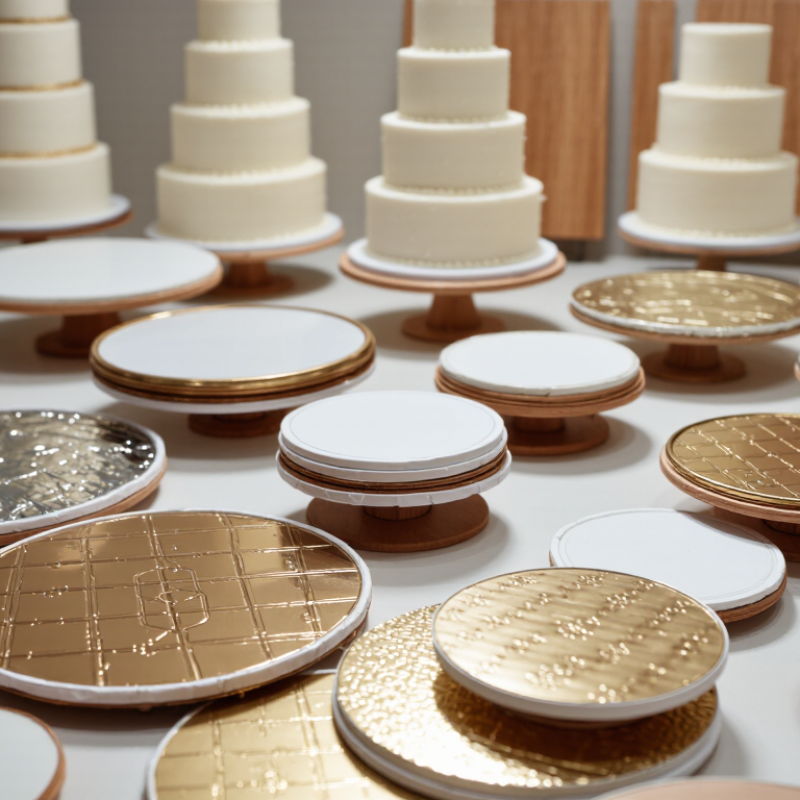
Cake drum performance depends on the board structure, not appearance alone. MDF offers excellent stiffness for heavy, multi-tier cakes. Its smooth surface also supports clean wrapping and accurate printing. However, MDF is heavy and requires careful moisture protection. A damp storage room can cause swelling or edge damage.

Corrugated cardboard provides lower weight and strong cushioning. Its fluted core absorbs handling shocks during delivery. FEFCO industry data reported European corrugated production near 48 billion square meters in 2023, showing its extensive packaging use. Yet flute direction matters. Poor alignment may create bending beneath a dense cake. Testing should include load weight, humidity exposure, and a two-hour room-temperature hold. Small details matter.

Laminated paperboard gives a polished surface with moderate rigidity. It suits lightweight cakes, retail display, and high-quality printed finishes. Smithers’ packaging research continues to identify fiber-based formats as major growth areas in sustainable packaging development. That does not make every paperboard drum automatically sustainable. Adhesive choice, coating thickness, and recycling compatibility require verification. In my supplier checks, I request edge-crush data, moisture testing, and food-contact documentation. Some specifications look impressive but lack test conditions. That is a warning. Cost comparisons can also mislead, because cheaper board may need thicker construction or extra wrapping. The best manufacturers explain these trade-offs clearly.

International Sourcing Checks: 20–40% Freight Cost, Incoterms, and Sample Tests

Top Cake Drum Board Manufacturers for Global Buyers

International Sourcing Checks: 20–40% Freight Cost, Incoterms, and Sample Tests

Selecting cake drum board manufacturers requires more than comparing unit prices. Freight can add 20–40% to the purchase cost, especially for dense boards and small shipments. Ask for carton dimensions, gross weight, pallet count, and loading capacity. A supplier should provide these figures before quoting. Otherwise, the cheapest offer may become expensive after booking.

Incoterms must stay consistent during comparison. EXW may exclude export handling and inland transport. FOB usually covers delivery to the loading port, but ocean freight remains separate. CIF includes freight and insurance to the destination port, not necessarily local fees. Request a landed-cost worksheet with currency, validity period, and destination charges. Small omissions matter.

Sample testing should mirror actual production. Check board diameter, thickness, edge smoothness, flatness, and resistance to bending. Place a finished cake on the sample for 24 hours. Watch for warping, soft spots, and surface marks. Test several pieces, not just one. Ask for material specifications, production-batch identification, and packaging photos. A sample can pass while a later batch fails. That risk is easy to underestimate. I would also record humidity during testing, because storage conditions can change performance. Incomplete records are a warning, even when the sample looks excellent.

FAQS

What minimum order quantity should buyers expect?

Common MOQs range from 500 to 5,000 pieces. Lower quantities support market testing, but unit prices may increase.

Why does monthly capacity matter?

Capacity shows whether a supplier can support steady growth. Ask for recent production records, not only stated figures.

How long does production usually take?

Lead time often ranges from 15 to 35 days after artwork approval. Add inspection and shipping time.

What should export support include?

Suppliers should explain carton sizes, pallet loading, shipping documents, and delivery terms clearly. Details matter.

Which food-safety documents should buyers request?

Request current certificates, covered production sites, food-contact declarations, migration reports, and batch traceability records.

How can buyers check board quality?

Inspect edge strength, thickness, flatness, moisture resistance, odor, foil adhesion, and cutting quality. Small defects can damage decorated cakes.

How much can freight add to purchasing costs?

Freight may add 20–40% to the purchase cost. Ask for carton weight, pallet count, and destination charges.

What should a practical sample test include?

Test several pieces under realistic conditions. Place a cake on each board for 24 hours and watch for warping.

Can a successful sample guarantee later batches?

No. A sample can pass while a later batch fails. Record humidity, batch details, and packaging conditions.

Which supplier metrics deserve the most attention?

Review MOQ, capacity, lead time, quality records, and export support together. I may overvalue capacity sometimes. Response speed also matters.

Conclusion

A Cake Drum Board is a rigid, food-safe support designed to improve the stability, presentation, and transport of decorated cakes. Buyers should compare board thicknesses from 6–15 mm, considering the cake’s weight, size, and handling conditions. Common options include MDF, corrugated cardboard, and laminated paperboard, each offering different advantages in strength, cost, moisture resistance, and sustainability. Load ratings should be confirmed through practical testing rather than appearance alone.

For international sourcing, buyers should evaluate MOQ, monthly production capacity, lead time, and export coverage. Reliable manufacturers may demonstrate systems such as BRCGS, ISO 22000, and FSC certification, together with suitable food-contact compliance documentation. Before placing an order, request samples, verify dimensions and load performance, and clarify packaging standards. Freight can represent 20–40% of total costs, so Incoterms, shipping routes, and customs responsibilities must be agreed in advance. These checks help global buyers select consistent, compliant, and cost-effective cake support products.

Liam

Liam

Liam is a dedicated marketing professional with a profound expertise in the industry, where he excels at highlighting the unique advantages of our core products. With a keen understanding of market trends and consumer needs, Liam frequently updates our company’s professional blog, providing......