Top Disposable Drink Carrier Suppliers for Global Buyers

Time:2026-10-03 Author:Aria
0%

Global buyers are rethinking how beverages move from counters to customers. The Disposable Drink Carrier now supports takeaway coffee, bubble tea, juices, and event catering. It must carry weight safely while presenting a clean, responsible brand image.

Grand View Research estimates the global foodservice packaging market reached approximately USD 84.3 billion in 2023. Its report also projects continued growth through 2030, driven by delivery, convenience, and expanding foodservice channels. Smithers’ packaging outlook similarly identifies sustainability, lightweight materials, and supply-chain efficiency as major industry priorities. These trends directly affect carrier selection, especially for buyers comparing molded pulp, recycled paperboard, and bagasse products.

Small details matter. A wet cup can weaken a paper handle within minutes. Poor slot sizing can cause two hot drinks to tilt during delivery. Experienced procurement teams therefore review material strength, coating performance, cup compatibility, packing efficiency, and factory quality controls. Certifications also deserve attention, including food-contact compliance and responsible forestry documentation where applicable.

This guide examines top Disposable Drink Carrier suppliers for international buyers. It focuses on practical evidence, not attractive catalogs alone. Supplier audits, production samples, testing records, minimum order quantities, and export experience can reveal meaningful differences. Price still matters. It is not everything. Freight costs, carton dimensions, lead times, and defect rates may change the real landed cost. No supplier is perfect, and specifications can be misunderstood across markets. Buyers should verify every claim before signing a purchase agreement.
Top Disposable Drink Carrier Suppliers for Global Buyers

Map Supplier Types: Paperboard, Molded Pulp, and rPET Carriers

Global buyers should map disposable drink carrier suppliers by material, not by catalog size. Paperboard carriers suit flat-packed café orders, quick branding, and efficient shipping. They usually cost less than molded alternatives, but moisture can weaken the folds. A supplier should show compression tests, recycled fiber content, and storage results under humid conditions. Small details matter.

Molded pulp carriers use formed fibers and often provide stronger cup separation. Their textured surface also feels more stable in delivery bags. However, tooling can raise minimum order quantities and extend sampling time. The U.S. Environmental Protection Agency reported an 80.9% recycling rate for paper and paperboard packaging in 2018. That figure supports fiber-based sourcing, but it does not guarantee local recyclability. Buyers must check coatings, adhesives, and collection systems.

rPET carriers offer moisture resistance and consistent dimensional accuracy. They can work well for chilled drinks and repeated handling during transport. Yet feedstock quality, color limits, and recycled-content verification require closer supplier control. The OECD Global Plastics Outlook reported that only 9% of global plastic waste was recycled in 2019. That number deserves attention. Recycled content alone is not a complete sustainability claim. Request third-party certificates, batch traceability, food-contact documentation, and drop-test records. In practice, paperboard may win on cost, molded pulp on cushioning, and rPET on wet-use performance. The best choice depends on route conditions, not marketing language.

Compare 2-, 4-, and 6-Cup Designs by Load Capacity and Stackability

Top Disposable Drink Carrier Suppliers for Global Buyers

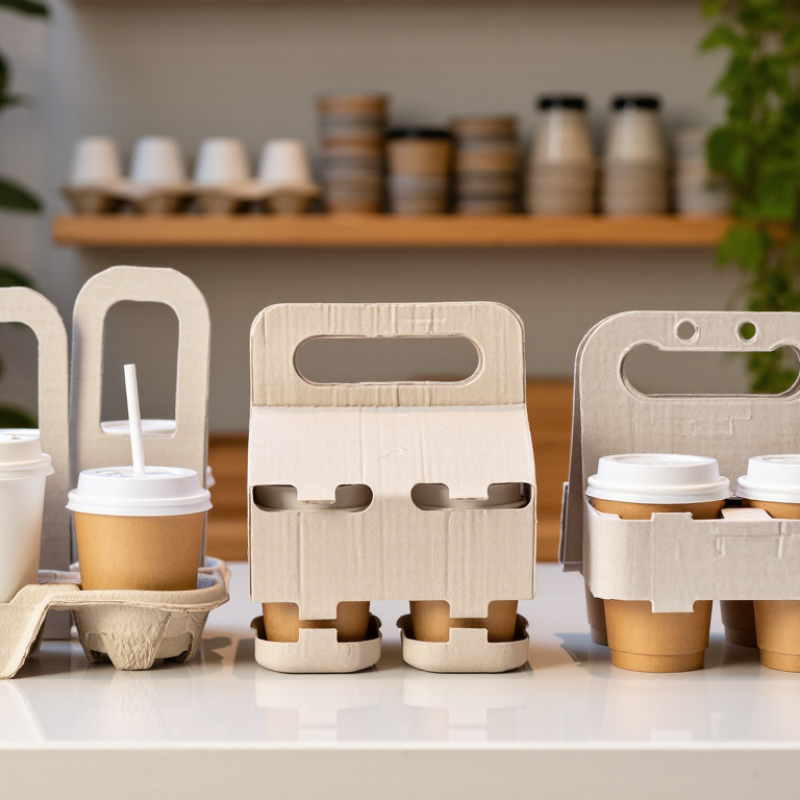
Choosing a disposable drink carrier starts with the cup count, but load capacity and stackability often decide performance. A two-cup carrier suits short deliveries and smaller orders. It usually leaves more space around each cup, reducing contact between hot beverages. However, unused sections can increase packaging volume.

Four-cup designs offer a practical middle ground. They support mixed drink orders without becoming difficult to handle. Check the base width, sidewall height, and divider strength. A carrier should hold filled cups during a 60- to 90-minute transport test. Condensation matters too. Wet molded fiber can soften faster than expected.

Six-cup carriers improve order efficiency for cafés, offices, and event service. Yet, higher capacity can reduce stability when the load is uneven. Stackability also needs close inspection. Empty carriers should nest tightly, release without sticking, and resist crushing under several stacked units. Ask suppliers for nesting height, compression results, and tested weight limits. Do not rely on cup count alone.

Material density changes everything. Recycled fiber, molded pulp, and coated paper can perform differently at identical dimensions. Request production samples from the actual factory, not only a specification sheet. Inspect the handle after repeated lifting. Small tears reveal weak forming or inconsistent batches. One limitation remains: laboratory results may not match humid warehouse conditions. Buyers should repeat tests with their own cup sizes, lids, and delivery routes.

Verify FDA 21 CFR and EU 1935/2004 Food-Contact Compliance

Top Disposable Drink Carrier Suppliers for Global Buyers

Compliance should be checked before price, printing, or delivery speed. FDA 21 CFR requirements depend on the carrier’s materials, coatings, adhesives, and intended food-contact conditions. A supplier should identify each component and provide current migration or extraction test reports. Testing through an ISO/IEC 17025-accredited laboratory adds useful credibility.

Paper looks safe. It is not automatically compliant. For the European market, Regulation (EC) No 1935/2004 requires food-contact materials to avoid harmful migration and unacceptable changes in taste or smell. Buyers should request traceability records, a material specification, and a Declaration of Compliance where applicable. For plastic-coated parts, Regulation (EU) No 10/2011 may also apply. Check the full construction, not only the paper grade.

Paper looks safe. It is not automatically compliant.

Industry data shows why this review matters. The OECD’s Global Plastics Outlook reported 460 million tonnes of plastic use in 2019, with only 9% recycled. The UNEP Turning off the Tap report projects that global plastic pollution could be reduced by 80% by 2040 through existing measures. These figures do not prove a carrier’s safety, but they highlight the need for better material choices and documented sourcing. A practical weakness remains: certificates can be outdated, incomplete, or limited to one production batch. Request batch traceability, recent test dates, and samples tested with hot, cold, acidic, or fatty beverages. Supplier claims deserve verification.

Assess Compostability Using ISO 18606, EN 13432, and ASTM D6400

Global buyers should assess disposable drink carriers through documented compostability standards, not attractive environmental claims. ISO 18606 evaluates packaging designed for organic recycling and requires biodegradation, disintegration, and material safety evidence. EN 13432 sets comparable requirements for industrial composting, including controlled temperature, humidity, and processing time. ASTM D6400 is widely used for plastics intended for municipal and commercial composting systems.

Ask suppliers for current test reports covering the complete carrier. That means handles, coatings, inks, adhesives, and moisture-resistant layers. A fiber carrier may appear compostable, yet its coating can delay disintegration. Details matter. Confirm whether certification applies to the finished item or only to one material. Request batch traceability, laboratory accreditation, and clear testing dates. Experienced buyers should also check the destination country’s accepted composting route, because industrial compostability does not guarantee backyard composting.

Practical trials can reveal weaknesses that documents miss. Place loaded carriers in humid storage, test handle strength, and inspect fiber separation after transport. Keep records of failures. I have seen specifications look convincing until a small adhesive strip was excluded from testing. That is an uncomfortable gap, but it deserves attention. Suppliers should explain disposal instructions in plain language and provide evidence that their claims match the certified product, not an earlier design. Waste operators may also reject certified items when local collection systems lack suitable composting capacity.

Compostability Benchmarks for Disposable Drink Carriers

The chart compares internationally recognized compostability thresholds. EN 13432 and ISO 18606 generally require at least 90% biodegradation within six months and disintegration of at least 90% within 12 weeks under controlled industrial composting conditions. ASTM D6400 commonly applies a 60% biodegradation threshold for plastic components within 180 days, while also requiring disintegration and ecotoxicity testing. Actual certification depends on the complete product, inks, adhesives, coatings, and test conditions.

Rank Suppliers by MOQ, Lead Time, Defect Rate, and Delivered Cost

Top Disposable Drink Carrier Suppliers for Global Buyers

Global buyers should rank disposable drink carrier suppliers with measurable purchasing data, not attractive catalogs. A practical scorecard weighs minimum order quantity, lead time, defect rate, and delivered cost. Supplier A may accept 5,000 units, but its 35-day lead time limits urgent replenishment. Supplier B requires 20,000 units, yet ships within 18 days. That difference matters during seasonal demand.

Defect rate needs physical verification. Request pre-shipment samples and inspect handles, seams, and cup openings under normal loading. A supplier reporting a 0.5% defect rate looks strong, but the calculation may exclude damaged cartons. Count rejected units and unusable packaging separately. Supplier C records 1.2% defects, but offers stronger carton protection and fewer arrival claims. Numbers need context.

Delivered cost should include unit price, tooling, inner cartons, freight, insurance, duties, and warehouse handling. A low factory quote can become expensive after delivery. In one comparison, Supplier A had the lowest MOQ, while Supplier C produced the lowest delivered cost at 40,000 units. Supplier B ranked highest for speed. The ranking changes with order volume, destination, and fuel surcharges. It is not permanent. Buyers should refresh quotes each quarter and test a small shipment before scaling. One weakness remains: defect data from suppliers is often self-reported, so independent inspection is worth the extra time.

Top Disposable Drink Carrier Suppliers for Global Buyers - Rank Suppliers by MOQ, Lead Time, Defect Rate, and Delivered Cost

Comparative supplier benchmark for standard molded-fiber and paperboard disposable drink carriers. Ranking reflects the combined performance of minimum order quantity, production lead time, quality rate, and estimated delivered cost.

Rank Supplier ID Primary Region Product Type Capacity MOQ
(Units)
Production Lead Time
(Days)
Defect Rate Delivered Cost
(USD / Unit)
Shipping Basis Typical Payment Term Data Status
1 Supplier A East Asia Molded-fiber 4-cup carrier 4 cups 10,000 18 0.8% $0.082 FOB port + ocean freight 30% deposit / 70% before shipment Qualified
2 Supplier B South Asia Recycled paperboard 4-cup carrier 4 cups 15,000 21 1.1% $0.076 FOB port + ocean freight 30% deposit / 70% before shipment Qualified
3 Supplier C Southeast Asia Molded-fiber 2-cup carrier 2 cups 20,000 24 0.9% $0.051 FOB port + ocean freight 30% deposit / 70% before shipment Qualified
4 Supplier D North America Recycled kraft 4-cup carrier 4 cups 5,000 12 0.6% $0.118 Delivered by regional truck Net 30 days Qualified
5 Supplier E East Asia Paperboard 2-cup carrier 2 cups 8,000 27 1.5% $0.047 FOB port + ocean freight 30% deposit / 70% before shipment Qualified
6 Supplier F Eastern Europe Recycled paperboard 4-cup carrier 4 cups 12,000 19 1.0% $0.094 Delivered by regional truck 30% deposit / 70% before shipment Qualified
7 Supplier G South America Molded-fiber 4-cup carrier 4 cups 7,500 31 1.8% $0.109 FOB port + ocean freight 40% deposit / 60% before shipment Qualified
8 Supplier H South Asia Recycled kraft 2-cup carrier 2 cups 25,000 35 2.2% $0.043 FOB port + ocean freight 40% deposit / 60% before shipment Qualified

Delivered cost is an estimated unit cost including product pricing, standard export packing, ocean freight, and typical destination handling for a full-container shipment. Actual values vary by order volume, destination, specifications, tooling, taxes, and freight conditions.

FAQS

How should I choose between two-, four-, and six-cup carriers?

Choose two cups for short deliveries and smaller orders. Four cups suit mixed orders and everyday handling. Six cups improve efficiency for offices, cafés, and events.

What should I inspect besides the cup count?

Check base width, sidewall height, divider strength, and handle construction. Cup count alone can mislead. Uneven loads may reduce stability.

How can I test a carrier’s load capacity?

Use filled cups during a 60- to 90-minute transport test. Include hot and cold drinks. Inspect spills, softening, tearing, and handle distortion afterward.

What makes a carrier stackable?

Empty carriers should nest tightly and release without sticking. They should resist crushing under several stacked units. Ask for nesting height and tested weight limits.

Why does moisture affect carrier performance?

Condensation can soften molded fiber faster than expected. Test carriers in humid storage conditions. A dry warehouse result may not predict delivery performance.

What supplier documents should buyers request?

Request material specifications, recent food-contact test reports, and batch traceability records. Testing from an accredited laboratory adds useful confidence. Still, paperwork can be incomplete.

How should food-contact compliance be verified?

Review every component, including coatings, adhesives, inks, and moisture barriers. Ask whether tests covered hot, cold, acidic, and fatty beverages. Paper is not automatically compliant.

How can compostability claims be checked?

Request current reports for the complete carrier, including handles and coatings. Confirm whether testing covers industrial composting or backyard composting. They are not the same.

What practical trials can reveal hidden weaknesses?

Load carriers, store them in humid conditions, and repeat lifting several times. Inspect small tears around handles and adhesive strips. Specifications may look stronger than reality.

What should happen after testing?

Record failures and compare results with the supplier’s claims. Repeat tests using your own cup sizes, lids, and delivery routes. Local waste systems may reject certified items.

Conclusion

Choosing the right Disposable Drink Carrier requires a structured comparison of materials, designs, compliance, and supplier performance. Global buyers can evaluate paperboard, molded pulp, and rPET carriers based on strength, moisture resistance, recyclability, and handling efficiency. Two-cup models are compact and easy to stack, while four- and six-cup designs provide greater carrying capacity but may require stronger construction and more storage space. Load testing and stackability checks are essential for safe transport and efficient warehouse use.

Before placing an order, buyers should verify food-contact suitability under FDA 21 CFR and EU Regulation 1935/2004. Environmental claims should also be supported by recognized standards, including ISO 18606, EN 13432, and ASTM D6400, where applicable. Supplier selection should consider minimum order quantity, production lead time, defect rate, quality-control procedures, and delivered cost. A balanced evaluation helps buyers secure reliable carriers that meet functional, regulatory, and sustainability expectations.

Aria

Aria

Aria is a dedicated marketing professional with a deep passion for innovative strategies and a keen understanding of our company's product offerings. With a wealth of experience in the industry, Aria excels at crafting engaging content that highlights the unique features and benefits of our......