Wholesale buyers rarely spot a weak cake board in a catalog image. They notice it when a tall sponge bends the center, a coated surface softens, or a gold edge arrives scuffed. Choosing the right Cardboard Cake Board is a practical decision about load, size, finish, and presentation. Small details matter. A board that looks sturdy may still flex beneath a layered cake.
This guide compares common types, including single-wall and double-wall boards, laminated finishes, and shaped options. It considers where each type fits, what to check in product specifications, and how pack size affects wholesale purchasing. Match board diameter to the cake and allow enough room for clean handling. Check thickness and construction, too. A glossy finish is not a strength rating.
A useful buyer’s rule is simple: “Choose for the cake’s weight, not the product photo.” No source material was provided to verify a named expert’s quotation, so assigning that line to a real specialist would be misleading. That matters. Reliable purchasing depends on testable details, not polished claims. Compare samples with actual cake loads, inspect edges after handling, and ask suppliers for clear specifications. Even then, results can vary with storage and humidity. A little caution helps.
A cardboard cake board is a firm, flat base placed beneath a cake, not a surface for baking. It may use solid paperboard, layered board, or corrugated construction. Each structure balances stiffness, weight, and cost differently. The board spreads a cake’s weight across a wider area, helping prevent a soft sponge from bending during lifting or display. A clean edge matters, too. It gives hands a stable grip when moving a cake from a counter to a box.
For wholesale buyers, board thickness, diameter, and surface finish should match the cake’s weight and shape. A tall cake needs a base that resists flexing; a broad cake needs support across its full span. Grease-resistant coatings can help protect the surface, but they do not make every board suitable for direct food contact. Check the supplier’s specifications. Then test a sample with a real cake, since frosting and humidity can change how the board performs. Still, no board is foolproof.
Material choice also has a wider packaging context. The American Forest & Paper Association’s 2023 recycling report estimated U.S. paper recycling at 65–69%, and corrugated box recycling at 71–76%. These figures describe paper products broadly, not cake boards specifically. Coatings and mixed materials may affect local recycling options, so buyers should verify disposal guidance rather than assume every board is recyclable.
Strength depends on more than board thickness. A single-layer board may suit cupcakes or a small sponge cake, while heavier cakes often need a denser, multi-layer construction. Compressed paperboard can feel firm under light pressure, but edges may soften when exposed to moisture. Corrugated cardboard adds a structured core that resists bending, though flute direction and edge quality can affect performance. Check how the board behaves beneath a real cake, not just in your hand.
Tips: Place a filled cake on the board and lift it from one edge. Watch for sagging, crushed corners, or a loose laminated surface. Test with your usual cake weight.
For wholesale buyers, compare board thickness, core structure, and surface finish together. A smooth coating can help resist grease, but it does not make every board waterproof. Larger diameters need particular care: even a strong center may flex near the rim. Ask suppliers for consistent specifications, then sample boards across more than one production batch. I have found that a board that looks sturdy can still disappoint under a wide cake. That judgment needs testing.
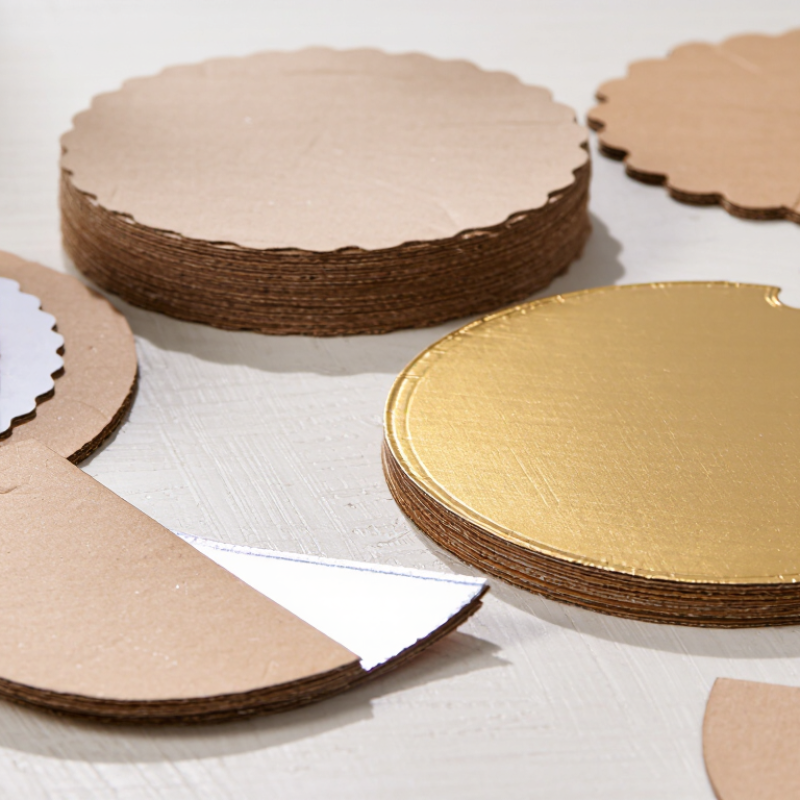
Wholesale buyers usually choose among corrugated boards, solid paperboard rounds, and laminated cake drums. Corrugated boards are light and economical, with a fluted core that helps support everyday cakes. They suit bakeries shipping standard sponge cakes, though heavy decoration can expose their limits. Solid paperboard rounds have a flatter profile and work well beneath lighter cakes or inside display boxes. Cake drums use thicker layers and often carry a foil-look or grease-resistant surface. They feel more substantial under tall, tiered cakes.
Finish matters as much as thickness. A coated surface helps resist buttercream oils and moisture, while an uncoated board may soften during refrigeration. Compare board diameter, edge finish, and stated load capacity using the actual cake weight. Ask suppliers for samples; a board can look rigid yet bend when lifted from one edge. Small details matter.
Material recovery also deserves attention. The American Forest & Paper Association reported a 68% U.S. paper recycling rate for 2022. That figure covers paper broadly, not cake boards specifically, and coatings or food residue may affect local sorting. So recycled content is useful information, but it is not a full disposal guarantee. Buyers should request material specifications and test boards under realistic storage conditions before ordering large quantities. A damp walk-in can change the result.
Thickness ranges are indicative of commonly available wholesale formats and can vary by supplier and specification. Thicker cake drums are generally chosen for heavier or tiered cakes, while thinner boards suit lighter cakes.
A cake board should support the cake and suit its presentation. For light sponge cakes or cupcakes, a single-wall corrugated board is often practical and easy to handle. Choose a board slightly wider than the cake, leaving room for a neat border or piping. A solid fiberboard option gives a smooth surface for clean, minimal designs. For heavier, taller cakes, use a thicker board or a reinforced base to reduce bending during transport.
Design matters, too. A foil-covered board can complement a polished finish, while a plain white surface keeps attention on colorful icing. Check that the board’s coating resists grease and moisture; buttercream can leave marks during display. For tiered cakes, each tier needs a firm board beneath it, with supports carrying the weight. A larger base can help with stability. Still, there is no perfect rule: cake recipes, fillings, and travel conditions all affect the load.
Tips: Test a sample with a cake of similar size and weight before placing a wholesale order. Press gently near the board’s edge and check for flex. Keep a little extra clearance for decoration, but avoid oversized boards that make handling awkward. Note the result; one test may not cover every cake style.
| Board Type | Typical Construction | Common Size Range | Best Match by Cake Size and Weight | Design and Display Suitability | Wholesale Buying Considerations |
|---|---|---|---|---|---|
| Single-Wall Corrugated Board | Fluted corrugated paperboard, usually with a flat paper liner on each side. | About 6–14 in (15–36 cm) across; round and square formats are common. | Everyday single-tier cakes in small to medium sizes, including many 6–10 in (15–25 cm) cakes. Choose a larger or stronger construction for heavier cakes. | Practical for simple finishes, bakery counter sales, and standard cake boxes. | Compare flute profile, board thickness, edge quality, and moisture resistance. Performance varies by paper grade and construction. |
| Double-Wall Corrugated Board | Two corrugated layers with liners between and around the flutes. | Commonly available in roughly 8–16 in (20–41 cm) sizes, depending on shape and supplier. | A sturdier option for larger or heavier single-tier cakes and cakes with substantial frosting or decoration. | Useful when a standard single-wall board may flex during lifting or transport. | Ask for board construction details and handling or load-test guidance for the intended cake and delivery conditions. |
| Foil-Covered Corrugated Board | Corrugated paperboard covered with a decorative foil-faced paper layer. | Common sizes include approximately 6–14 in (15–36 cm), in round, square, and rectangular shapes. | Light to medium-weight celebration cakes where a finished presentation surface is preferred. | Metallic finishes can complement birthdays, anniversaries, and other event cakes. The foil layer is a surface finish, not an indicator of load capacity. | Check that the food-contact surface is suitable for its intended use and that the finish resists scuffing during packing. |
| Solid Fiberboard Cake Card | Dense, compressed paperboard with a smooth, flat profile. | Often offered in small and medium formats, commonly around 4–12 in (10–30 cm). | Lightweight cakes, cupcakes, or individual portions; select a thicker or larger support for heavier cakes. | Low-profile appearance works well when minimal board visibility is desired. | Useful for high-volume assortments. Confirm thickness, stiffness, and suitability for chilled or moist products. |
| Thick Drum Board | Several paperboard or corrugated layers laminated together, often with a decorative outer wrap. | Frequently available from about 8–20 in (20–51 cm), with larger formats offered by some suppliers. | Large, heavy, or tall single-tier cakes that need a more rigid base. Match the board size to the cake and its decorations. | The deeper edge provides a substantial presentation platform and can be finished to suit an event design. | Compare total thickness, edge finish, surface wrap, and supplier-recommended use. Do not infer a safe load from thickness alone. |
| Scalloped or Shaped Board | Corrugated or solid paperboard cut into a decorative outline, sometimes with a printed or foil finish. | Typically sold in selected standard sizes; dimensions and usable support area vary by shape. | Small to medium cakes whose footprint fits fully within the board’s stable support area. | Decorative edges can frame the cake and reduce the need for additional presentation trim. | Check the flat central area, not just the board’s widest measurement, when confirming cake fit. |
| Square or Rectangular Corrugated Board | Single- or double-wall corrugated paperboard cut to a geometric shape. | Commonly available in a range of side lengths, including formats for sheet cakes and rectangular bakes. | Sheet cakes, loaf-style cakes, and designs with a rectangular footprint. Select a board with adequate margin on all sides. | Creates a clean, structured display and can align neatly with rectangular packaging. | Specify length and width separately; confirm corner quality and compatibility with the intended box. |
| Multi-Tier Cake Support Board | Rigid cardboard or corrugated board used beneath an individual tier; commonly paired with internal dowels or other supports. | Cut or supplied to fit each tier, generally matching the tier’s base footprint. | Tiered cakes when each tier is properly supported. Use a separate board under each tier and suitable structural supports through the tiers below. | Helps with assembly, transport, and separating tiers for service. | Confirm board fit and rigidity for each tier. A cake board alone does not replace dowels or other engineered supports. |
Selection note: As a practical starting point, choose a board that is slightly wider than the cake—often about 1–2 in (2.5–5 cm) wider in diameter for a round cake—and check that the cake is fully supported. Actual performance depends on board materials, cake weight and shape, moisture, handling, and transport conditions; confirm suitability with the supplier for the intended application.
Wholesale buyers should compare cake boards by intended use, not appearance alone. A thin round board may suit cupcakes, while a tall layered cake needs a firmer base. Check diameter, thickness, and stated load capacity against the cakes your customers actually sell. A 3 mm board can feel sturdy in hand yet flex under a heavy cake, so test a sample with a realistic load.
Look closely at the surface and edge finish. Grease-resistant coatings can help prevent buttercream or oil from marking the board, but confirm that the material is suitable for food contact and request supporting documentation. Check whether the finish stays smooth after contact with a damp cake. Worth checking. Small surface defects may show through pale icing or look untidy in display cases.
Compare product tolerances, carton quantities, and packing methods, too. Ask how much board diameter can vary between units, and inspect boards from more than one carton if possible. Flat, well-protected packaging helps reduce bent corners during storage and shipping. A lower unit price may not be a saving if damaged boards create extra sorting work. I have found that specifications can look clear on paper, yet still leave practical questions unanswered; a small trial order can reveal handling issues before a larger purchase.
Corrugated boards are light and economical for everyday cakes. Solid paperboard rounds suit lighter cakes. Thicker cake drums support taller, heavier designs.
Leave enough room for piping or a neat border. Avoid excess clearance, which can make handling awkward.
Choose a thicker or reinforced base. Each tier also needs a firm board, with supports carrying the weight. Test the full setup.
A grease-resistant coating can help limit buttercream marks and moisture damage. Check that the surface stays smooth after contact with a damp cake.
Test a sample with a cake of similar size and weight. Press near the edge and lift it carefully. It may flex.
Compare diameter, thickness, stated load capacity, edge finish, and product tolerances. A 3 mm board can still bend under a heavy cake.
Request supporting documentation for the material and its coating. Appearance alone does not confirm suitability. Worth checking.
Not necessarily. Coatings and food residue may affect local sorting. Broad paper recycling rates do not guarantee that a specific board can be recycled.
Inspect boards from more than one carton and check for bent corners. A sample may not represent every cake style, but it can reveal handling issues.
A Cardboard Cake Board provides a supportive base that helps cakes stay level during decorating, storage, and transport. Its strength depends on factors such as material thickness, layered or reinforced construction, and surface finish. Common wholesale options include lightweight single-layer boards, sturdier corrugated or multi-layer boards, and decorative boards in different shapes and sizes. Each type offers a different balance of support, appearance, and cost.
To choose the right board, match its dimensions and load capacity to the cake’s size, weight, and design. Larger or heavier cakes generally need thicker, more rigid support, while smaller cakes may work well with lighter boards. When comparing wholesale options, check board thickness, construction, available sizes, edge and surface quality, and packaging quantities. Considering these specifications together can help buyers select reliable boards for a range of cake styles and handling needs.

AOTONG